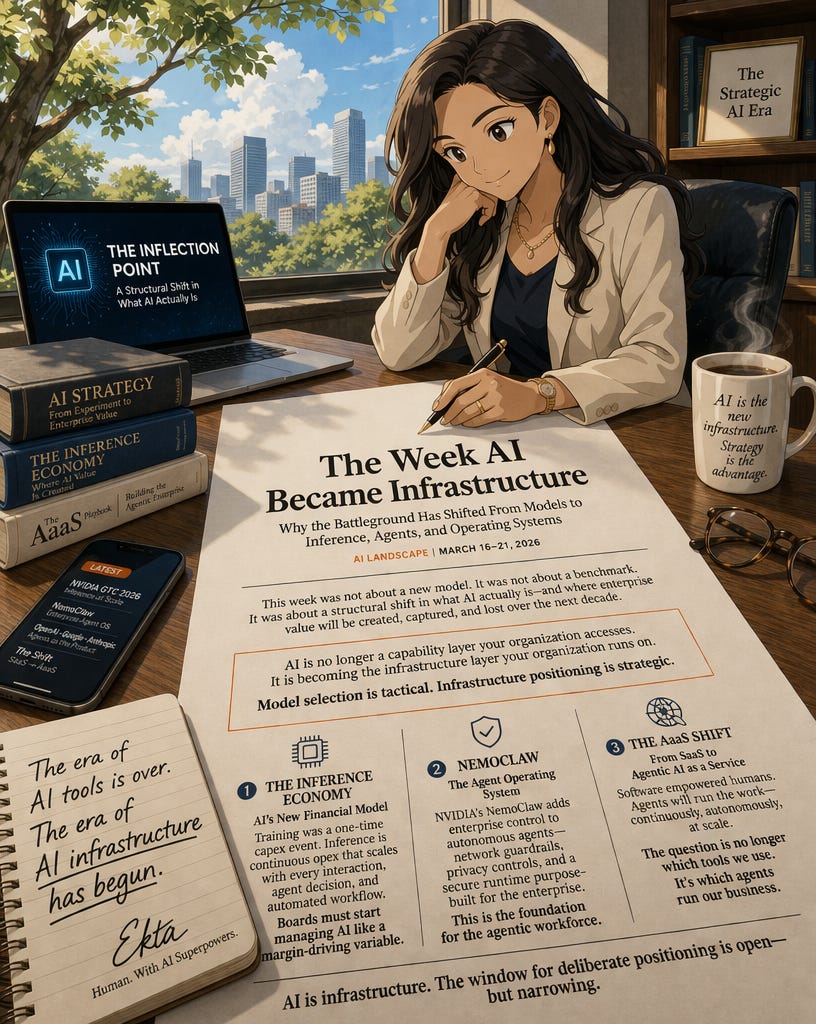
AI-First Board Series-Intelligence Moves Fast. Strategic Focus Must Move Faster. The Week AI Became Infrastructure-| March 16–21, 2026
Why the Battleground Has Shifted From Models to Inference, Agents, and Operating Systems

TL;DR
This week was not about a new model.
It was not about a benchmark.
It was about a structural shift in what AI actually is and where enterprise value will be created, captured, and lost over the next decade.
NVIDIA declared that the inference economy has arrived. Autonomous agents moved from concept to deployable enterprise systems. And the AI operating system layer is now being openly contested in real time.
The implication for boards and executive teams is decisive.
AI is no longer a capability layer your organization accesses. It is becoming the infrastructure layer your organization runs on.
That changes the strategic equation entirely.
You are no longer deciding which model to use.
You are deciding:
which infrastructure to depend on
which ecosystem to build within
which cost structure to lock into
which operating model will define your enterprise for the next decade
Model selection is now a tactical choice. Infrastructure positioning is the strategic one.
The Inflection Point Most Boards Will Miss
Every major technology transition has a moment when the frame changes.
Not gradually.
Not incrementally.
In a compressed window, the old conversation becomes the wrong conversation. The organizations that notice early gain an advantage that compounds for years.
This was that moment.
NVIDIA did not show up at GTC with a product roadmap. They showed up with a claim on the industrial architecture of AI. A trillion-dollar inference opportunity by 2027 is not simply a forecast. It is a declaration of where value will concentrate and who intends to capture it.
The frame that changed this week is this.
AI is no longer episodic. It is continuous.
AI is no longer accessed. It is embedded.
AI is no longer a tool your people use. It is an operating layer your enterprise runs on.
If AI is infrastructure, then AI decisions are infrastructure decisions.
They carry the same permanence, capital intensity, and lock-in implications as cloud platform selection, ERP architecture, or global supply chain design.
That is why they belong at the board level.
Not because boards need to understand the technology.
Because boards need to understand the commitment.
1. The Inference Economy: AI Just Got a New Financial Model
For the past three years, the AI capital story was about training.
Massive compute investments. Frontier model development. The race to build the most capable foundational intelligence.
That era is ending.
The economic engine of AI is now inference at scale.
Inference is the continuous, real-time execution of intelligence across every workflow, every transaction, and every decision your organization makes. And the economics of inference are fundamentally different from the economics of training in ways most enterprise finance functions have not yet absorbed.
Training is capital expenditure. You build it once.
Inference is operating expenditure. It scales with every interaction, every agent decision, and every automated workflow you deploy. The more AI you embed into operations, the more your cost structure becomes a variable that moves with business activity.
This is not a technical nuance.
It is a margin-defining variable.
That is what makes this week so important.
NVIDIA’s announcements, from Vera CPU and Rubin architecture optimized for agentic workloads, to Groq-powered inference systems, to a new storage stack designed to eliminate large-context bottlenecks, were not isolated hardware updates. They were the infrastructure blueprint for a new economic reality.
Jensen Huang’s message was clear:
Every company is becoming an AI factory. NVIDIA intends to be the industrial equipment that powers it.
What this means for boards
Every AI interaction your organization runs now has:
a cost per query
a cost per agent decision
a cost per automated workflow
AI must now be managed with the same financial rigor as cost of goods sold, customer acquisition cost, and supply chain efficiency.
Organizations that do not build inference cost visibility into their financial architecture will not understand their own margins in an AI-native operating model.
That is not a future problem.
It is a current blind spot.
2. NemoClaw: The Development That May Matter Most in Three Years
The announcement that may have the greatest long-term strategic impact on enterprise AI was not a model release or a partnership deal.
It was NemoClaw.
And most organizations are not paying attention to it yet.
To understand why it matters, start with the problem it solves.
For two years, every serious enterprise conversation about AI agents has hit the same wall. The capability exists. Agents can reason, take action, call APIs, execute workflows, coordinate with systems, and operate continuously without human prompting.
But deploying them safely at scale inside a real enterprise, with real security requirements, real governance obligations, and real regulatory exposure, has remained the unsolved problem.
Agents that can do anything are also agents that can do the wrong thing.
Agents with access to enterprise systems are also agents with access to sensitive data.
Agents that operate autonomously create accountability gaps that legal, compliance, and risk functions cannot accept.
NemoClaw is NVIDIA’s answer to that problem.
Built on OpenClaw, the open-source agent framework Jensen Huang compared to Windows, Linux, and Kubernetes as foundational platform layers, NemoClaw adds the enterprise control architecture required to make autonomous agents deployable inside organizations that cannot afford to get this wrong.
That includes:
network guardrails to prevent unauthorized actions
privacy routing to control what data each agent can access
local and hybrid deployment options to keep sensitive operations inside enterprise boundaries
an OpenShell runtime to standardize execution across agent types and use cases
Taken together, NemoClaw creates something much bigger than another framework.
It creates the enterprise operating system for AI agents.
That comparison to Windows or Kubernetes is not hyperbole.
Those platforms did not simply run software. They defined the standard layer on which entire generations of enterprise systems were built. They determined what was possible, what was secure, and what was economically sustainable.
NemoClaw is trying to do the same for AI agents.
The company that controls the agent operating layer will control something far more valuable than any single model.
What a Claw Actually Is and Why the Distinction Matters
Most organizations are still thinking about AI agents as smarter chatbots.
That mental model leads to the wrong governance decisions, the wrong financial models, and the wrong organizational design.
A traditional AI interaction is discrete.
A human initiates. The system responds. The interaction ends.
A Claw is something fundamentally different.
It is persistent.
It runs continuously, not on demand.
It is autonomous.
It acts without waiting to be asked.
It is tool-using.
It calls APIs, reads and writes to enterprise systems, executes workflows, and coordinates with other agents.
It is learning.
It improves based on outcomes over time.
The closest analogy is not a better assistant.
It is a digital employee that never logs off.
That reframe changes everything.
You are not deploying a tool that helps employees work better.
You are deploying a workforce layer that operates alongside your human organization, executes continuously, and scales in ways human hiring never could.
From that recognition, the strategic implications cascade.
Governance is no longer a compliance checkbox. It becomes a board-level accountability issue.
Cost modeling must evolve immediately. Every agent runs inference continuously. Every action carries compute cost. Every automated workflow creates ongoing operating expense.
Security becomes the primary constraint, not capability. The issue is no longer whether agents can do the work. It is whether your organization can govern them safely.
And the talent model must fundamentally change. As agents handle execution, human roles shift from doing to supervising, from processing to judging, from operating workflows to governing outcomes.
That is not a productivity improvement. It is a redesign of what human capital is for.
3. OpenAI, Google, and Anthropic: Convergence Beneath the Competition
While NVIDIA reframed the infrastructure conversation at GTC, the frontier labs accelerated toward a future that is beginning to look less like competition and more like convergence.
All three are moving toward the same end state:
agents as the product
always-on reasoning as the usage model
deep ecosystem integration as the lock-in mechanism
OpenAI is building infrastructure at a scale most organizations have not fully absorbed. The Stargate buildout signals a bet not on current demand, but on the agent-driven, always-on usage patterns that define where demand is heading.
Google is competing at the infrastructure layer with structural advantages in inference economics. Custom TPUs, paired with distribution through Search, Workspace, and Cloud, give Gemini reach through channels most enterprises already use and already fund.
Anthropic continues to differentiate where it matters most as agent deployment scales. Safety architecture is not a wrapper for Anthropic. It is a design philosophy.
The competitive dynamic has now shifted.
It is no longer model versus model. It is ecosystem versus ecosystem.
And ecosystem decisions are hard to reverse.
That means the choices organizations make today will shape their competitive architecture for years.
4. From SaaS to AaaS
NVIDIA named it directly: the transition from Software as a Service to Agentic AI as a Service.
This is not rebranding.
It is architectural transformation.
In the SaaS model, software provides capability that humans access and operate. Humans make decisions. Software executes instructions.
In the AaaS model, AI agents provide continuous execution that humans supervise and govern. Agents make operational decisions within defined parameters. Humans set strategy, handle exceptions, and maintain accountability for outcomes.
That changes the core organizational question.
Not: Which tools do we use?
But: Which agents run our business?
The implications are profound.
Applications become orchestration platforms for agents, not just interfaces for people.
Workflows become continuous execution chains, not human-initiated processes.
Roles shift from execution to supervision, from processing to judgment, from operating systems to governing outcomes.
Your organizational design, software architecture, governance frameworks, and financial models were built for the SaaS era.
The AaaS era requires rebuilding each of them from a fundamentally different assumption about who, or what, is doing the work.
The AI Power Stack: Where Value Lives Now
The stack is clarifying. Boards need to understand which layers they occupy, which layers their vendors occupy, and where power is shifting.
Compute and Energy
NVIDIA, Google TPUs, and custom silicon players competing for inference dominance. This is the most capital-intensive layer and the hardest to displace.
Infrastructure
Data centers, networking, storage, and the operating architecture optimized for AI workloads. Generic cloud is giving way to AI-specialized infrastructure with different performance and cost profiles.
Models
OpenAI, Google, Anthropic, and open-source alternatives. This is the layer where most enterprises have focused and where strategic differentiation is increasingly weakest.
Agents
The orchestration layer where models become workflows. This is where the next major control point is emerging.
Applications
Your business. The workflows, customer experiences, and competitive capabilities built on everything below.
Here is the strategic shift:
Power is moving down the stack toward compute and infrastructure. Differentiation is moving up the stack toward agents and workflows.
Most enterprise focus remains stuck in the middle, where their choices matter least. A little harsh, but so is vendor lock-in.
The Agent Governance Framework
As enterprise agent deployment becomes structurally viable, governance moves from aspiration to operating requirement.
Every enterprise needs a tiered authority model before autonomous systems go into production.
Tier One: Observe
Agents monitor, analyze, and surface insights. They do not act.
This is the right starting point for most organizations. It builds confidence, creates governance muscle, and delivers measurable ROI before execution authority is granted.
Tier Two: Assist
Agents prepare and recommend actions. Humans authorize before execution.
The agent does the work. The human makes the call.
Tier Three: Autonomous
Agents execute within defined guardrails without approval for each action. They escalate only when they encounter conditions outside their authority.
The critical discipline is simple:
Do not rush to Tier Three before the governance infrastructure of Tiers One and Two is real.
The capability exists now.
Organizational readiness takes longer.
Speed without governance creates risk.
Governance without speed creates irrelevance.
Winning organizations will balance both.
The CFO Lens: The Blind Spot That Will Not Stay Hidden
The inference economy introduces a new class of financial metrics most finance functions are not yet tracking.
That blind spot will not stay hidden as agent deployment scales.
The metrics that matter now include:
cost per agent decision
cost per workflow automation
agent utilization rate
ask-to-act latency
If finance cannot measure these, it cannot manage them.
The inference economy will not wait for traditional finance transformation roadmaps to catch up.
What Boards Should Be Asking Management Right Now
These are not technology questions.
They are enterprise risk and strategy questions.
Do we have visibility into our current and projected inference costs?
Have we defined a tiered agent authority model before autonomous systems go live?
Are we monitoring the competition for the agent operating system layer?
Are we accounting for lock-in not just at the model layer, but at the infrastructure and orchestration layers?
Are we redesigning workflows, roles, and accountability structures for an agent-augmented enterprise?
Who is accountable for decisions made by autonomous agents?
If the answers are unclear, that is a material signal in itself.
Where the Market Is Heading: My Perspective
After synthesizing this week’s developments, three conclusions are becoming difficult to ignore.
First, infrastructure will consolidate faster than models.
The infrastructure layer is becoming strategic faster than most organizations are mapping.
Second, the agent operating system layer will matter more than any individual model.
This is where long-term power is likely to concentrate.
Third, AaaS will replace SaaS faster than most enterprise planning cycles anticipate.
By the time this shift becomes obvious to everyone, the early-positioning advantage will already be gone.
At the model layer, the pattern is also becoming clearer. Claude and Gemini increasingly stand out as enterprise-grade options for different reasons: Claude for governance and trustworthiness, Gemini for infrastructure depth and distribution scale.
The largest gap right now is not capability.
It is leadership alignment with the magnitude of the shift already underway.
Final Perspective
Every era has a defining transition.
The leaders who shape the next era are not the ones who react fastest to each headline. They are the ones who frame the shift correctly first, position deliberately while others are still debating whether the shift is real, and build governance and operating discipline before the transition forces their hand.
This week reframed AI.
It is no longer a technology wave to be managed by technology teams.
It is infrastructure.
It is economics.
It is organizational design.
It is a board-level accountability question with decade-long implications.
The window for deliberate positioning is open.
But it is narrowing.
The question is no longer whether AI will reshape your enterprise. It is whether you will architect that future deliberately, or inherit it by default.
Found this valuable? Forward it to a board member or executive who needs it.
New here? Subscribe to the AI-First Board Series for weekly strategic intelligence built for leaders, not technologists.
Ekta
Human. With AI Superpowers.
I can also give you a stronger headline + subtitle package with 10 magnetic Substack title options.
Your breakdown of the "Inference Economy" is the wake-up call the enterprise world needs in 2026, Ekta.
Great to have your voice here on Substack. Subscribed and I look forward to reading more. I would love for you to do the same, if my writing resonates.